How to adopt AI as a CRO
July 27, 2026
Most CROs already know AI could take work off their plate. That was never the hard part.
The hard part is the meeting where someone from quality asks, "And how do we defend this in an audit?" - and the room goes quiet. The capability is obvious. The path to deploying it without putting your compliance posture at risk is not. So the project stalls, the pilot never ships, and a competitor who solved the compliance question first starts pulling ahead.
The real blocker isn't the AI. It's the black box.
Walk into a QA or regulatory team and pitch "AI in the trial," and the resistance you hit is rarely about whether the AI works. They'll happily concede it's useful. What they can't accept is an output they can't explain.
A black box gives you an answer with no traceable reasoning behind it. In a regulated trial, an answer you can't trace is an answer you can't defend. The auditor asks why a query was flagged, who reviewed it, and what the system did - and "the model decided" is not an answer that survives an inspection.
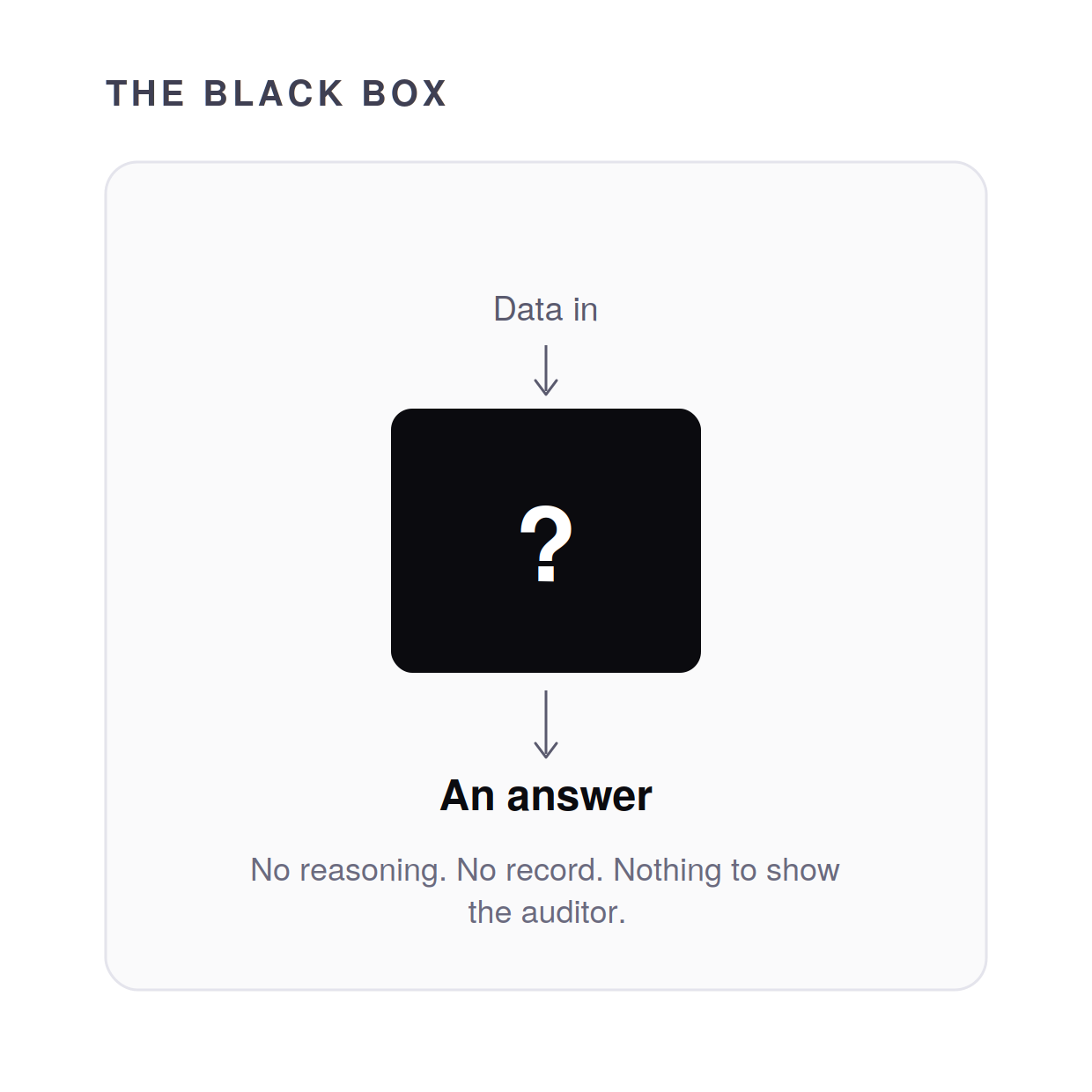
So the distrust is correct. It's just aimed at the wrong target. The problem was never artificial intelligence. The problem is opacity. Solve the opacity and the objection dissolves, because what regulatory teams actually need isn't the absence of AI. It's a record.
What compliant-by-design actually requires
Four principles separate AI you can defend from AI you can only hope about.
- Human-in-the-loop on every action. The AI proposes, a qualified person rejects. No clinical decision is made autonomously. The human keeps agency and accountability, and the system is built to require it rather than allow it to be skipped.
- Full auditability. Every action the AI takes is logged, timestamped and attributable. When the inspector asks what happened, the trail is already there. You're not reconstructing it under pressure.
- Quality by design. Compliance is built into the workflow, not bolted on at the end as a validation scramble. The controls live inside the process, so doing the work correctly and documenting it are the same act.
- Data isolation. Your trial data stays yours. It isn't quietly feeding an external model, and it isn't leaving the boundary you control. Where the AI runs and what it trains on is a decision you make, not a default you inherit.
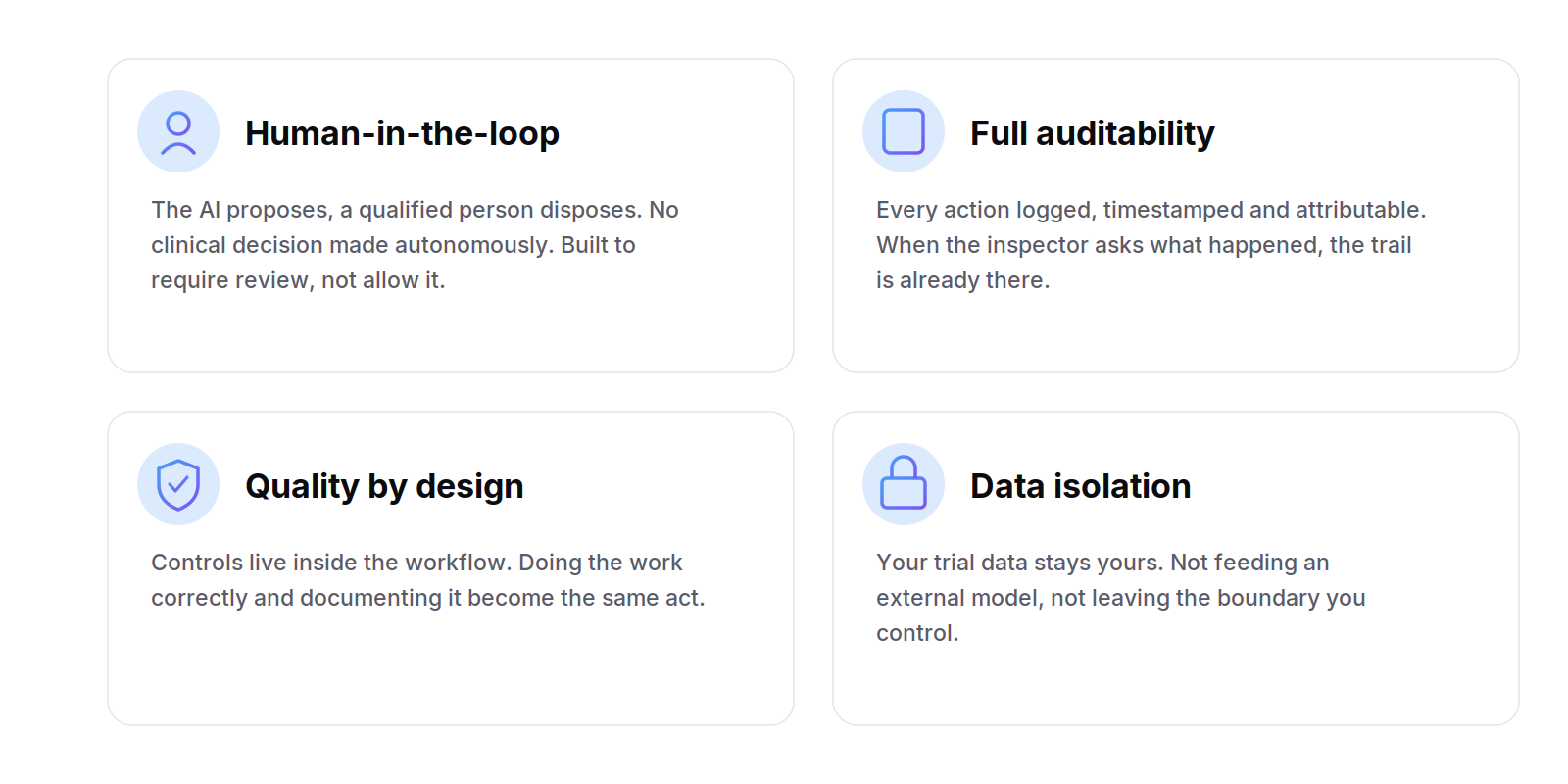
The common thread: the system produces an audit trail rather than an opaque output. That single property is what turns AI from a risk you carry into evidence you can show.
Integrated agents beat bolt-on tools
There are two ways to bring AI into a trial, and they age very differently.
The first is the bolt-on. You take a standalone AI tool and stitch it into the edges of your existing stack. It works in a demo. But it lives outside your validated workflow, so every action it takes has to be reconciled back into the systems of record by hand, and every reconciliation is a new seam where the audit trail can break. You've added capability and subtracted defensibility. Ages like milk.
The second is the integrated agent. The AI lives inside the trial infrastructure, operating on the same data, inside the same workflow, under the same controls as everything else. There's no seam to reconcile because there's no outside. The agent's actions are logged the way every other action is logged, in the system the auditor already trusts. The Brad Pitt of aging well.
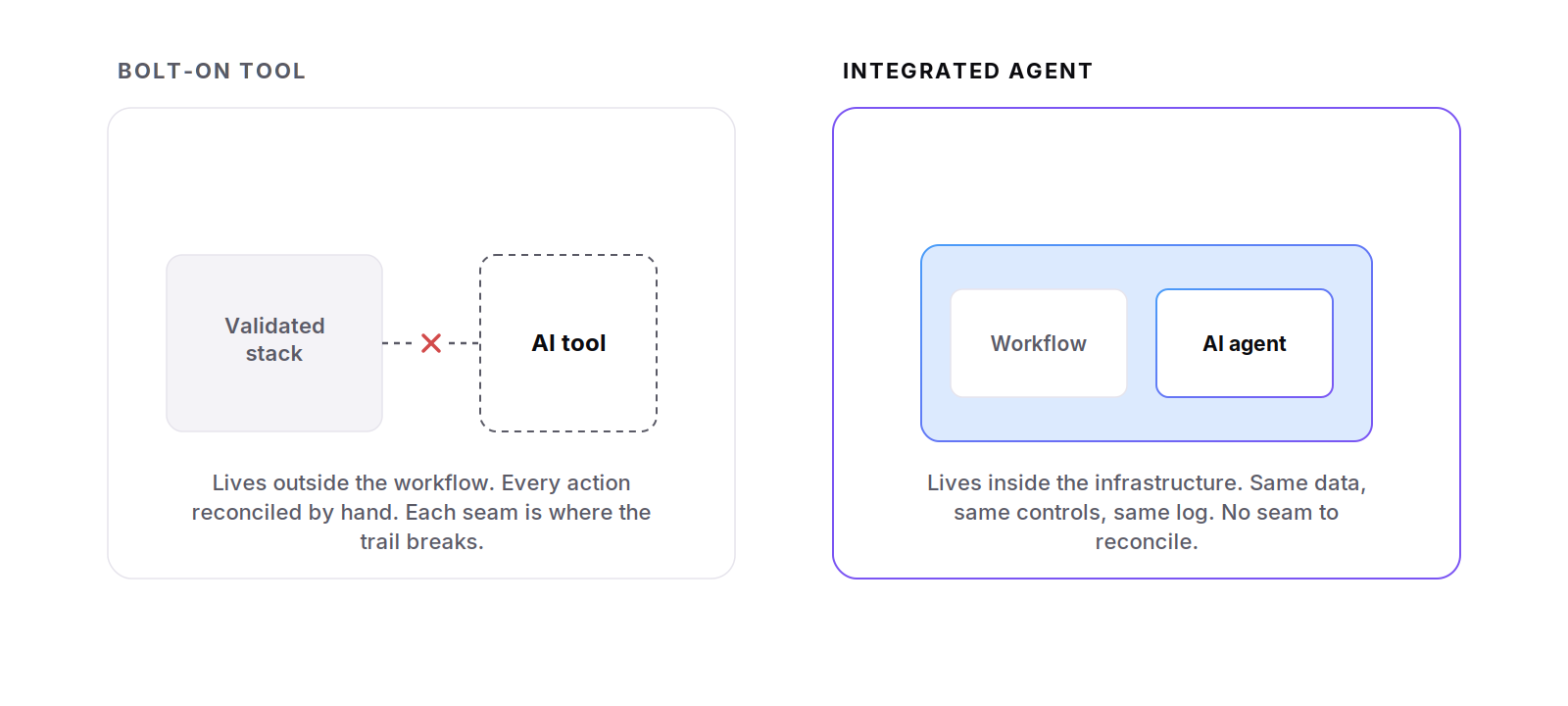
Defensibility comes from integration. A tool bolted onto the side adds tremendous complexity, increases risk and requires additional assessment and validation/maintenance overhead. An agent built into the workflow keeps complexity and thus risk at a minimum.
What this looks like with Carelane
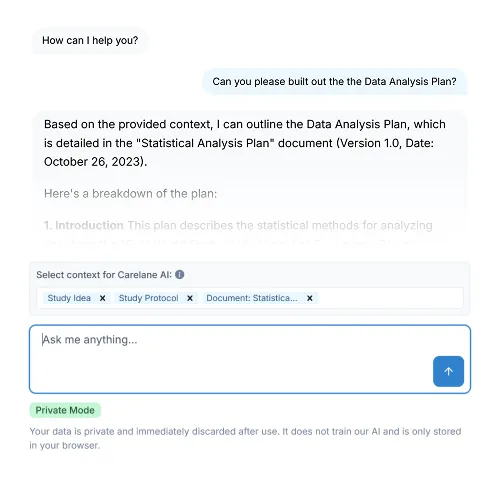
Every action an agent takes is logged and reviewable, the same way a person's action would be. The human-in-the-loop checkpoints are part of the design, not an optional setting someone can turn off under deadline pressure. And because the compliance controls are built into the infrastructure, there's no separate validation project (or minimal, depending on your needs) to fund and staff before you can begin. The thing that usually makes AI adoption a six-month committee exercise is already done.
The result is that "adopt AI" stops being a program with its own risk register and becomes a feature of the platform you're already running.
Start small. Prove the trail. Then expand.
You don't have to bet the portfolio to find out whether this works.
Pick one contained, auditable use case. A single repetitive verification task, one study, one workflow where the manual cost is obvious. Turn the agent on there, with the human-in-the-loop checkpoints active and the logging running. Then do the thing that actually de-risks adoption: pull the audit trail and look at it. See that every action is attributable. Hand it to your QA team and let them try to poke holes in it.
When the trail holds up on the small case, you expand on evidence instead of faith. Each step out is backed by a record from the step before. By the time AI is running across your studies, you're not hoping it's defensible. You've already watched it be defensible, repeatedly, on cases you chose precisely because you could scrutinise them.
.png)
The takeaway
Compliant AI adoption isn't about getting permission to take a risk. It's the opposite. It's about choosing infrastructure where the compliance is already built in, so there's no leap to take.
When the audit trail is a property of the system rather than something you assemble after the fact, adopting AI stops being the bold move that needs defending. It becomes the safe one. The CROs that understand this won't be the ones who were braver than everyone else. They'll be the ones who saw that the question was never "do we dare?" - it was "did we build it right?"
Ready to try Carelane?
From protocol to a complete study build in minutes. Experience the world's fastest infrastructure for modern clinical trials.