What people mean when they say EDC is going away
What people mean by it, and how much of it we would bet on.
"In a few years there won't be an EDC anymore."
You hear this at conferences a lot these days, and the room usually nods. Some of the people nodding are two years into a five-year EDC contract.
We build clinical trial software, and an EDC is part of it, so we're not neutral on this and we have good reason to take the sentence seriously.
We think it's partly true. The trouble is that it's really three predictions, and the person saying it rarely tells you which one they mean. They aren't equally likely to come true, so it's worth taking them apart.
Predictions
People have been predicting things like this for a while, and it helps to look at how the earlier predictions turned out.
In 2006 a workshop leader at the DIA annual meeting was quoted as saying that EDC "will obviate the need for data management" (Pratt, 2006). Twenty years later there are still data managers, and they have a lot more data to look after. Tufts CSDD counts how many data points a study collects in total, across all participants and including what comes from central labs and devices. For the average Phase III protocol that number was about 930,000 in 2012 and is 5.9 million now (Getz et al., 2026).
In December 2023 a trade article reported a vendor CEO's projection that the industry may move beyond EDC "in a year or two" (Buntz, 2023). That was three years ago.
Neither of them was wrong about the direction, though. EDC did change what data managers do, it just didn't make them unnecessary. And vendors do report that a shrinking share of trial data is entered through the EDC (Buntz, 2023; IQVIA, 2026). What both got wrong was when, which is why we won't name a year ourselves.
Typing
If you've been nodding without being quite sure what is being predicted, the easiest way in is to ask what an EDC does. It does four things.
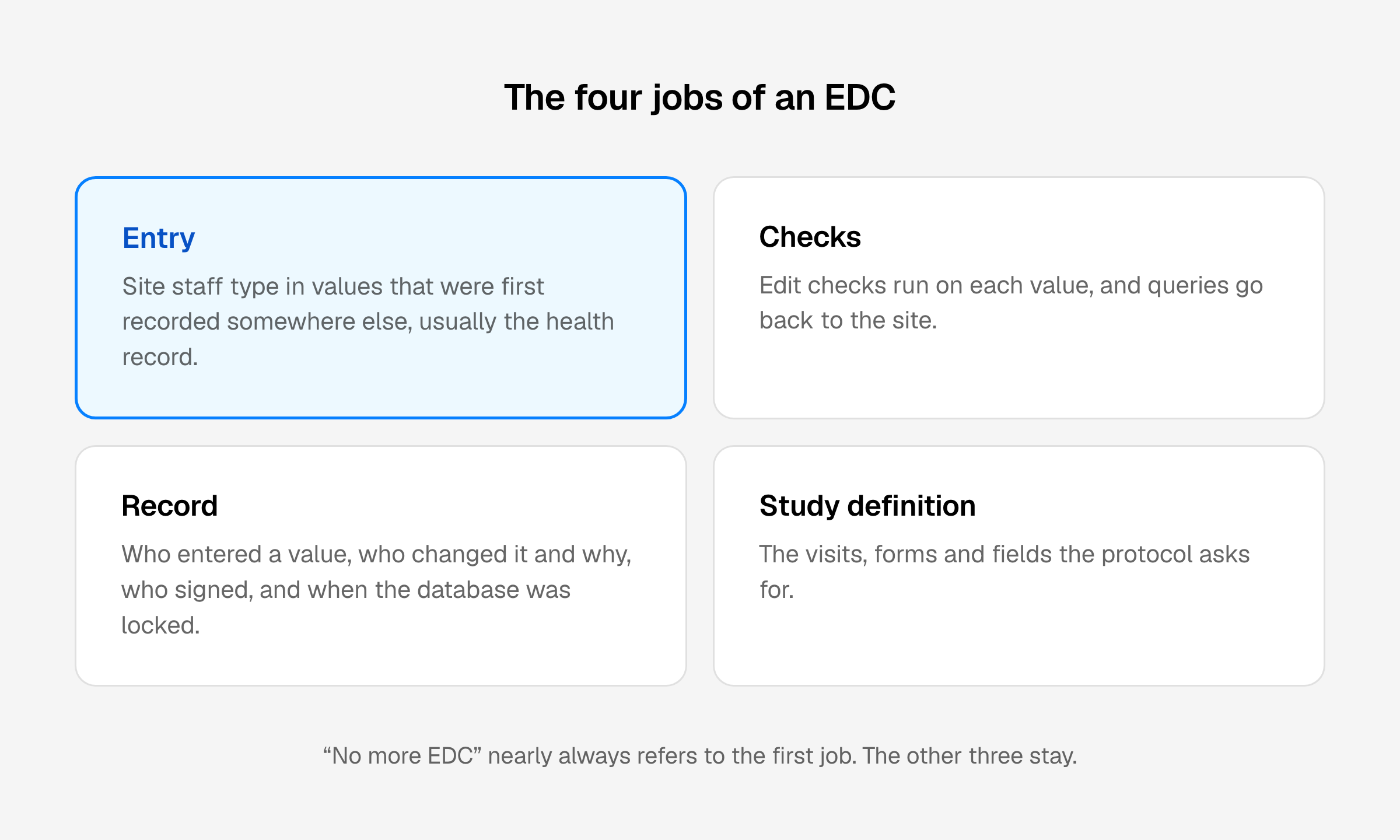
When people say EDC is going away, they nearly always mean the first of these, the typing. Nobody is proposing to run trials without checks, without an audit trail, or without a definition of what has to be collected. IQVIA published a white paper this November with the title "Moving Beyond EDC". Its own FAQ asks whether the approach eliminates EDC, and the answer starts with "No" (IQVIA, 2026).
We agree that the typing should go. Look at what happens today. A coordinator reads a value in the health record and types it into the EDC, and later a monitor visits the site to check that the two match. A TransCelerate paper that analysed data from past trials concluded that this check, which is called source data verification, has "limited value as a quality control measure" (Sheetz et al., 2014). So the data gets copied by hand, and then someone is paid to check the copy.
The question is what replaces the typing. There are three answers going around, and they are quite different from each other.
EHR-to-EDC
The first answer is that the hospital's record system sends the value to the study directly. The lab and the wearable do the same, and nobody has to retype anything. The hospital part of this usually goes by the name EHR-to-EDC.
That sounds obviously right, so why hasn't it happened? You might guess that regulators are in the way, but they have been open to this for a long time. The FDA published guidance on electronic source data in 2013, and on using health record data in trials in 2018. ICH E6(R3), adopted in January 2025, doesn't use the term "electronic data capture" at all. It talks about "data acquisition tools" instead, and it names a person, a machine or another computer system as possible origins of the data, with extraction from an electronic health record as an example. It even says that "unnecessary transcription steps between the source record and the data acquisition tool should be avoided" (ICH, 2025a).
The hard part is the hospitals. In the TransFAIR study, six trials at three European hospitals collected the same data twice, once by hand and once by automatic transfer. The transfer covered 16.9% of all data points, and nearly all of those were lab values and vital signs (Ammour et al., 2023). Researchers from Sanofi and Flatiron Health later looked at five oncology trials and found 86% of the data points eligible for transfer, but only 43% of the data could be retrieved through FHIR, the standard interface. The rest depended on additional steps such as technology-enabled chart abstraction (Salcuni et al., 2025).
So transfer works today, but mostly for structured data and mostly at large centres. It doesn't work yet for what a physician dictated into a letter, and it doesn't work at a small site that has no integration at all. Veeva says in its 2026 trend report that EHR integrations "may be a viable trend for the largest sites but have been challenging to scale and adopt" (Veeva, 2026). If you're running a multicentre trial, that means transfer isn't enough on its own as long as some of your sites can't offer it.
AI
The second answer doesn't depend on the hospitals getting their data in order. Software reads the documents a site already has, such as discharge letters, lab reports and scans, and suggests the values for the form. A person then compares each suggestion with the source and accepts or rejects it. This is usually what's meant when someone says AI will do the data entry.
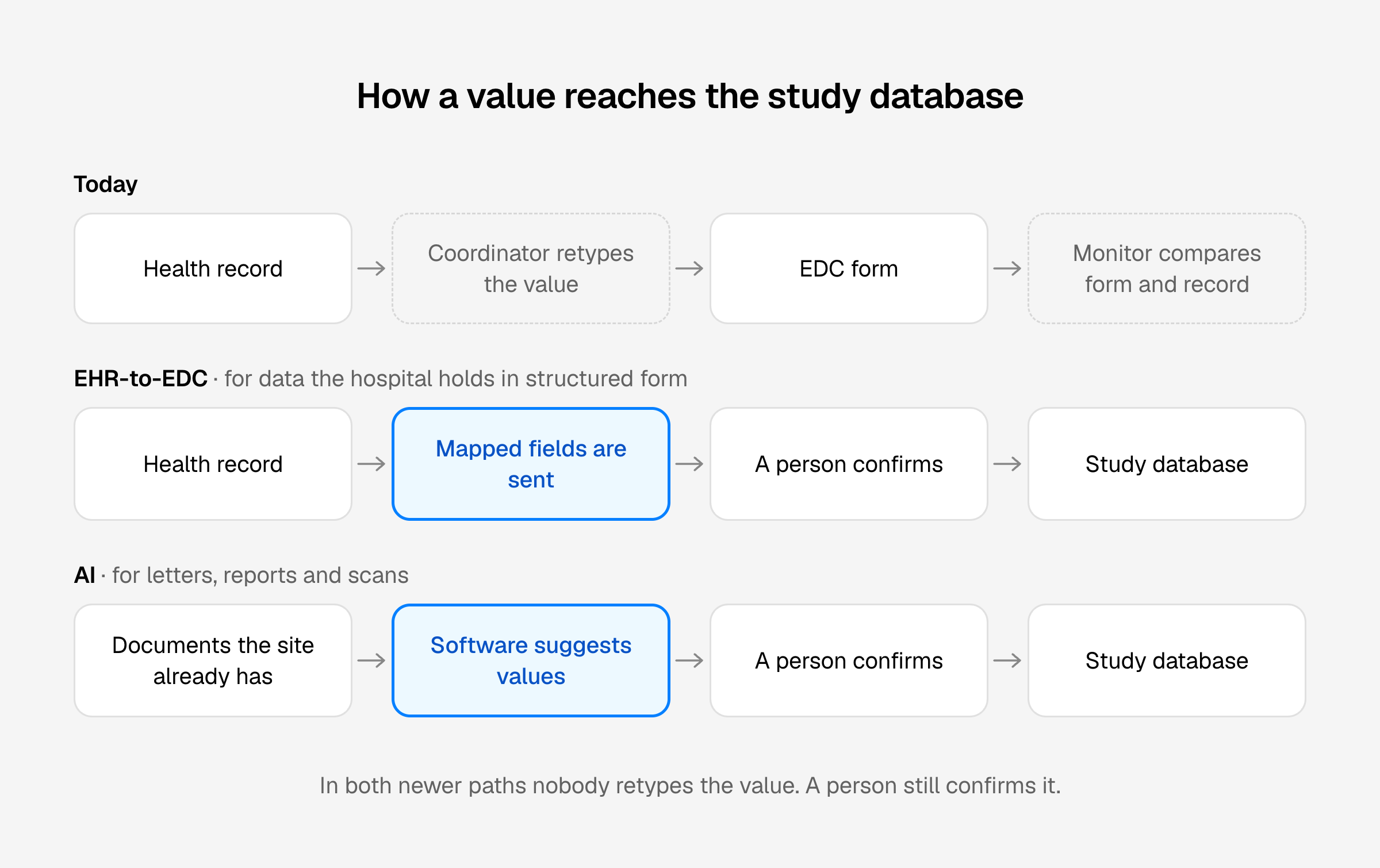
This is the version we work on at Carelane. The advantage we see is that it also covers unstructured data, and that a site doesn't need an integration for it. The open question is how reliably it works across thousands of sites, with all their document types and languages. That still has to be shown.
One thing regulators have made clear is that a qualified person has to review what the software produced before it becomes a record. The FDA's first warning letter about AI, which we wrote about in April, was about drug manufacturing, but we can't see why the principle would be different for trial data.
Notice that the form is still there in this version. Site staff go through the values in it, but they no longer type them.
Platforms
The third answer has more to do with how software is sold than with how data is collected. The idea is that data from entry forms, patient diaries, randomisation, labs and devices all ends up in one platform, where the entry form is just one input among several. ICH M11, which was adopted in November 2025, fits into this because it defines a structured, machine-readable protocol (ICH, 2025b). The hope is that a study build can then be derived from the protocol and no longer has to be configured by hand.
This is mostly what the large platform vendors mean, and of the three it changes the least. All four jobs still get done, just not by a product you buy separately. Whether a sponsor then says "we have no EDC anymore" or "the EDC is part of our platform" is something the procurement department can decide.
Records
Whichever of the three you look at, some system still has to know what the protocol asks for, and it has to store every value together with where it came from, who or what entered it, and who changed it and why. The investigator still has to sign, and an inspector still has to be able to follow all of it.
We think this part gets harder. When a coordinator types a value, its history is simple. When the value was sent by a hospital system, or suggested by software and accepted by a nurse, the record has to show exactly that, or nobody will be able to tell later how the value got there. So there will be less typing, but the record will have more to keep track of.
ICH calls a system like this a data acquisition tool. Our guess is that most people will just keep calling it the EDC, the way we still say we dial a number.
Timing
How long will this take? We don't know, but it helps to look at how long it took to get from paper to EDC.
The FDA's rule on electronic records took effect in 1997. About ten years later, a survey of 259 Canadian trials found that 41% of them used an EDC system, and that was already more than earlier surveys had suggested (El Emam et al., 2009). In 2017 all 257 companies in a Tufts CSDD survey used EDC, but about a third of them were still using paper case report forms as well (Tufts CSDD and Veeva, 2017). So it took about twenty years, and even then paper wasn't gone.
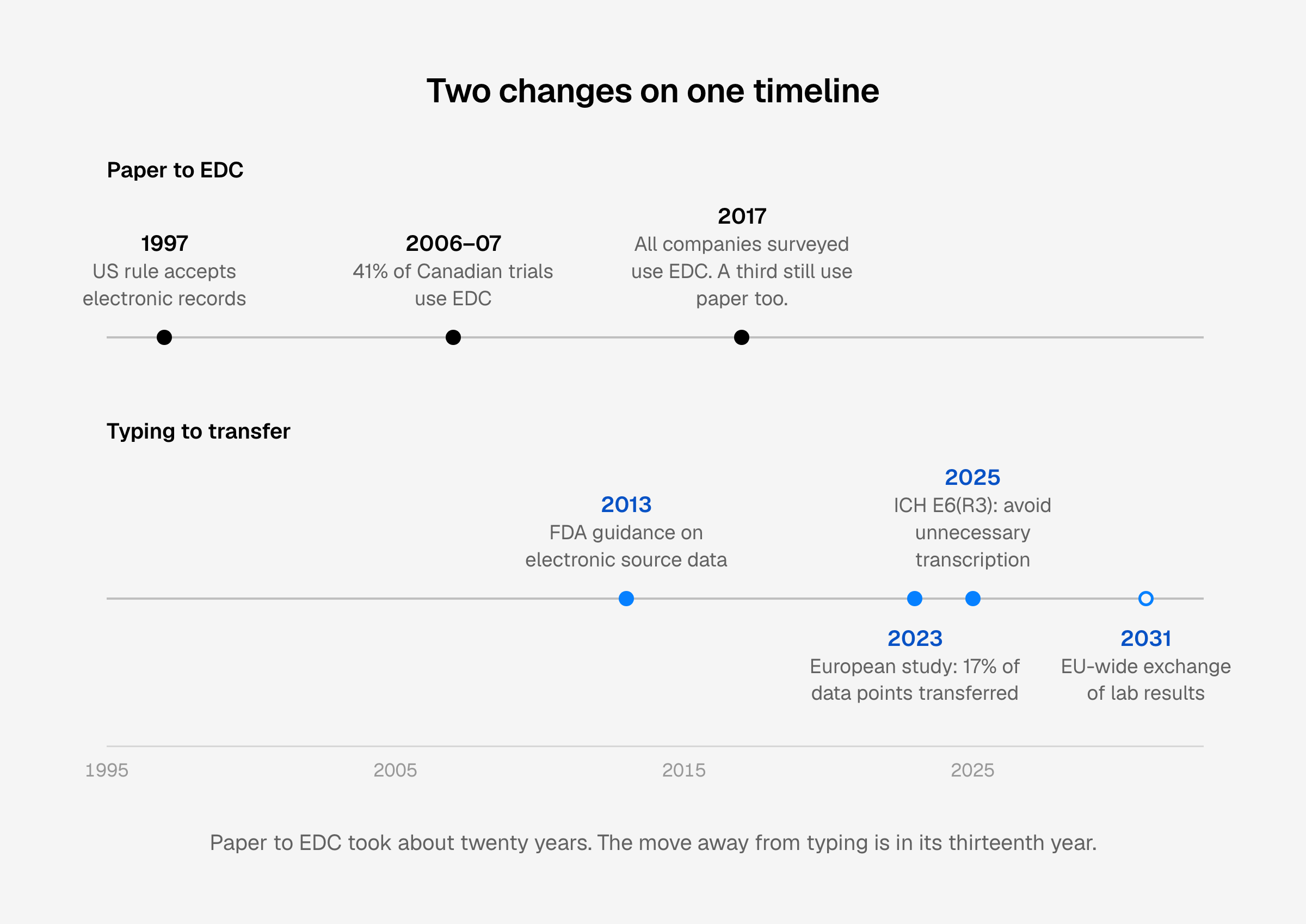
And that was the easier change, because all a site had to do was type into a browser what it used to write on paper. This time either thousands of hospitals have to provide their records in a consistent form, or sponsors and inspectors have to get comfortable with values that were suggested by software.
A few dates are known. In the US, vendors of certified health record systems had to provide a standard FHIR interface to their customers by the end of 2022 (ONC, 2022). In the EU, the European Health Data Space is supposed to make patient summaries and prescriptions exchangeable in all member states from March 2029, and medical images, lab results and discharge reports by March 2031 (European Commission, 2025). And a Phase III that starts on a conventional EDC this year can easily still be running on it in 2030, so there will be EDCs in a few years whatever else happens.
Bets
Given how the earlier predictions went, here is what we would bet on and what we wouldn't.
We'd bet that the share of hand-typed values keeps falling, and that it falls first at large centres in the US, where the FHIR interface is already mandatory. Site staff will probably spend more of their time in these systems reviewing data than entering it. And we think the record will matter more in five years than it does today, because it will have to keep more kinds of origin apart.
What we wouldn't bet on is a specific year, or on one of the three answers replacing the other two. It seems more likely that most sponsors will use a mix for quite some time, with transfer where the hospital supports it, software reading documents where it doesn't, and typing for the rest.
Questions
The next time someone tells you there won't be an EDC in a few years, a few questions will tell you which version they mean.
- Which part goes away, the typing, the separate product, or the record?
- Where do the values come from instead, and for which share of our case report form does that work today, at the sites we use?
- Who confirms a value that nobody typed, and where can an inspector see this?
- What happens to the studies that are already running?
If you're choosing software this year, we wouldn't plan on typing staying forever, and we wouldn't plan on it being gone by 2028 either. We'd ask whether the system can take a value from a person, from another system and from a suggestion, and whether its record shows which of the three it was.
If you'd like to see how we approach this at Carelane, or if you think we got something wrong, we'd like to hear from you.
References
- Ammour, N. et al. (2023). TransFAIR study: a European multicentre experimental comparison of EHR2EDC technology to the usual manual method for eCRF data collection. BMJ Health & Care Informatics, 30(1), e100602.
- Buntz, B. (2023). Data infrastructure and AI shape the future of clinical trials. Drug Discovery & Development, 7 December 2023.
- El Emam, K. et al. (2009). The use of electronic data capture tools in clinical trials: Web-survey of 259 Canadian trials. Journal of Medical Internet Research, 11(1), e8.
- European Commission (2025). European Health Data Space Regulation (EHDS). In force since 26 March 2025.
- FDA (1997). Electronic Records; Electronic Signatures. 21 CFR Part 11, final rule, effective 20 August 1997.
- FDA (2013). Electronic Source Data in Clinical Investigations. Guidance for Industry, September 2013.
- FDA (2018). Use of Electronic Health Record Data in Clinical Investigations. Guidance for Industry, July 2018.
- Getz, K. et al. (2026). Insights informing strategies for optimizing the collection of clinical trial data. Therapeutic Innovation & Regulatory Science, 60(2), 563–574.
- ICH (2025a). E6(R3) Guideline for Good Clinical Practice. Adopted 6 January 2025. Section 2.12.2 and Glossary.
- ICH (2025b). M11 Clinical electronic Structured Harmonised Protocol (CeSHarP). Adopted 19 November 2025.
- IQVIA (2026). Moving Beyond EDC to a Unified, Real-Time Data Ecosystem. White paper, 6 November 2026.
- ONC (2022). On the Road to Cures Update: Certified API Technology. Office of the National Coordinator for Health IT, 19 August 2022.
- Pratt, T. (2006). Data Management: R.I.P. or Brave New World? Applied Clinical Trials, 1 October 2006.
- Salcuni, P., Ammour, N., Cariou, M. et al. (2025). Optimizing data collection: assessing EHR-to-EDC data transfer potential across structured and unstructured data. AMIA Informatics Summit 2025.
- Sheetz, N. et al. (2014). Evaluating source data verification as a quality control measure in clinical trials. Therapeutic Innovation & Regulatory Science, 48(6), 671–680.
- Tufts CSDD and Veeva (2017). 2017 eClinical Landscape Study.
- Veeva (2026). 2026 Clinical Data Trend Report.
