When the sponsor owns the platform
How CRO competition is shifting from switching costs to track record, and why that's good news.
"The sponsor will provide the eClinical platform, the CRO will operate within it."
These days, more and more RFPs include such a line. At first glance it reads like the ground is being pulled out from under the CRO: no licence, no admin rights, no system that anchors the relationship. If the CRO doesn't own the software, they remain swappable throughout the trial.
We think it's an opportunity.
A familiar model, now available to small teams
Sponsor-owned platforms are not new. Large pharmaceutical companies have long held their own licences, configurations and admin rights, with CROs working inside them. What has changed is access. Modern, cloud-native eClinical systems now make the same arrangement practical for a 30-person biotech without a clinical IT department.
We should be transparent about our part in this. Carelane builds a platform that lets smaller sponsors own their clinical infrastructure, and we encourage them to take the leap. Seems fair that we also set out what the shift means for CROs, and why that’s actually good news - for the strong performers.
What switching costs did to competition
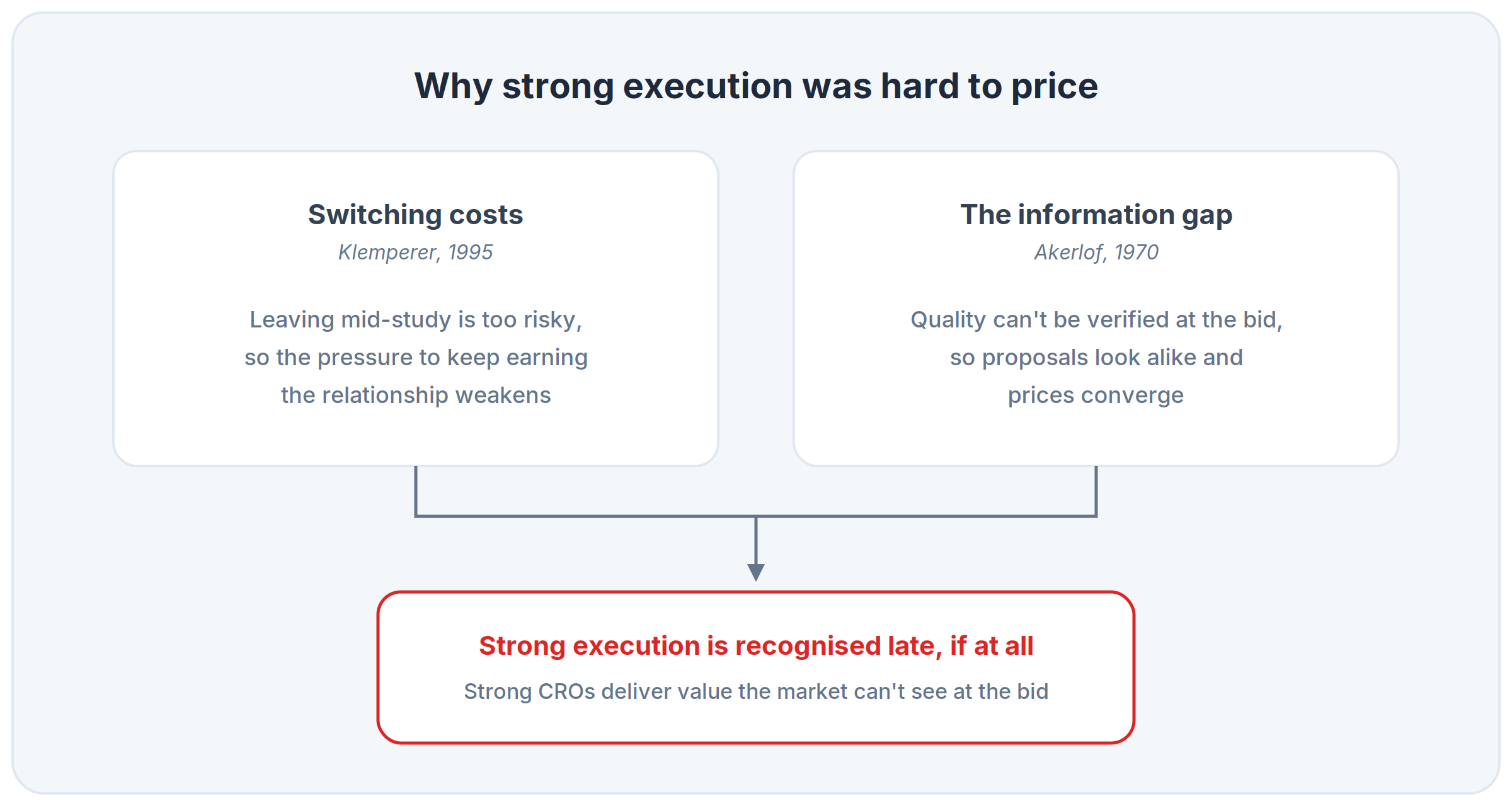
Economists have studied switching costs for decades. The core finding is simple: when leaving a supplier is expensive, competition shifts from ongoing performance to winning the initial contract. Once a customer is committed, the pressure to keep earning the relationship weakens (Klemperer, 1995).
In clinical trials, this dynamic has been especially strong. When changing CRO meant re-platforming a live study, with data migration, revalidation and retraining, sponsors stay with a partner even when performance falls way off the mark. The alternative is simply too risky for timelines and data integrity.
A second effect makes this even worse. At the bid stage, sponsors struggle to verify operational quality. Most proposals describe similar capabilities and similar efficiency, and the evidence that would distinguish them only appears once the study is running. Akerlof (1970) showed that when buyers cannot observe quality upfront, prices converge and high-quality providers are under-rewarded.
Together, these effects meant that excellent execution was hard to price.
The case for CRO-owned systems
Let's not be unfair and simply describe CRO-owned platforms as a retention device only. They exist for sound reasons. A CRO running many studies across many sponsors benefits from one validated environment, one set of SOPs and one trained team. That standardisation lowers cost and reduces error, and for many sponsors it has been the most practical option available.
The question is not whether that model was reasonable. It is what happens when sponsors of every size can own their platform, and the system no longer defines the relationship.
Where the advantage moves
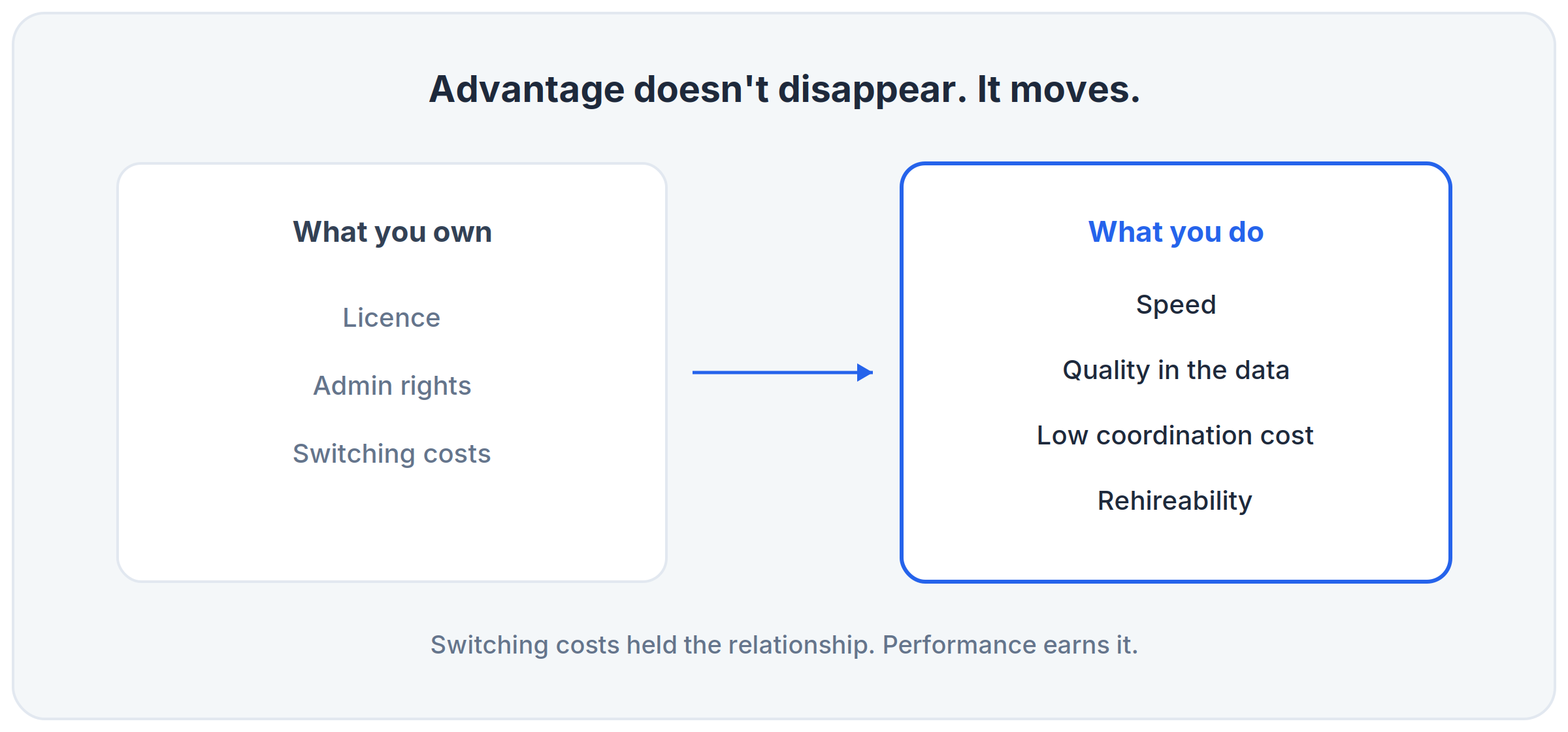
Competitive advantage does not disappear on a sponsor-owned stack. It moves from what a CRO owns to what a CRO does. Four capabilities become visible and measurable in a way they rarely were before.
- Speed on a platform you did not configure. The relevant measure is days from handover to first patient in. Because the sponsor keeps the same system across studies, it can compare each CRO against the one before.
- Quality that shows in the data. Query rates, protocol deviations and monitoring findings sit in an environment the sponsor can query directly. A CRO's track record becomes observable evidence rather than a claim in a proposal.
- Low coordination cost. How much sponsor time does the partnership consume in escalations, rework and follow-ups? This rarely appears in a capabilities statement, yet it strongly shapes whether a sponsor wants to work together again.
- Rehireability. Can the sponsor bring the CRO into its next trial without a new discovery phase, training cycle or set of templates? On a shared platform, a second engagement can start almost immediately.
All four are comparative, and the comparison is now easy to make. This addresses exactly the information problem described above. For CROs that perform well, a sponsor-owned platform works like a scoreboard they have long lacked.
Willingness to be compared is a signal
CROs that welcome a sponsor-owned environment signal strength and competence. Those that resist it risk being read as avoiding comparison.
Signalling theory explains why sponsors will draw this inference. When buyers cannot observe quality directly, they infer it from choices that would be costly for a weaker provider to make (Spence, 1973). Operating on the sponsor's platform is such a choice. It exposes a CRO's speed, data quality and coordination cost to direct comparison with every partner before and after it. A CRO confident in those numbers gives up little; one that relies on opacity gives up a great deal.
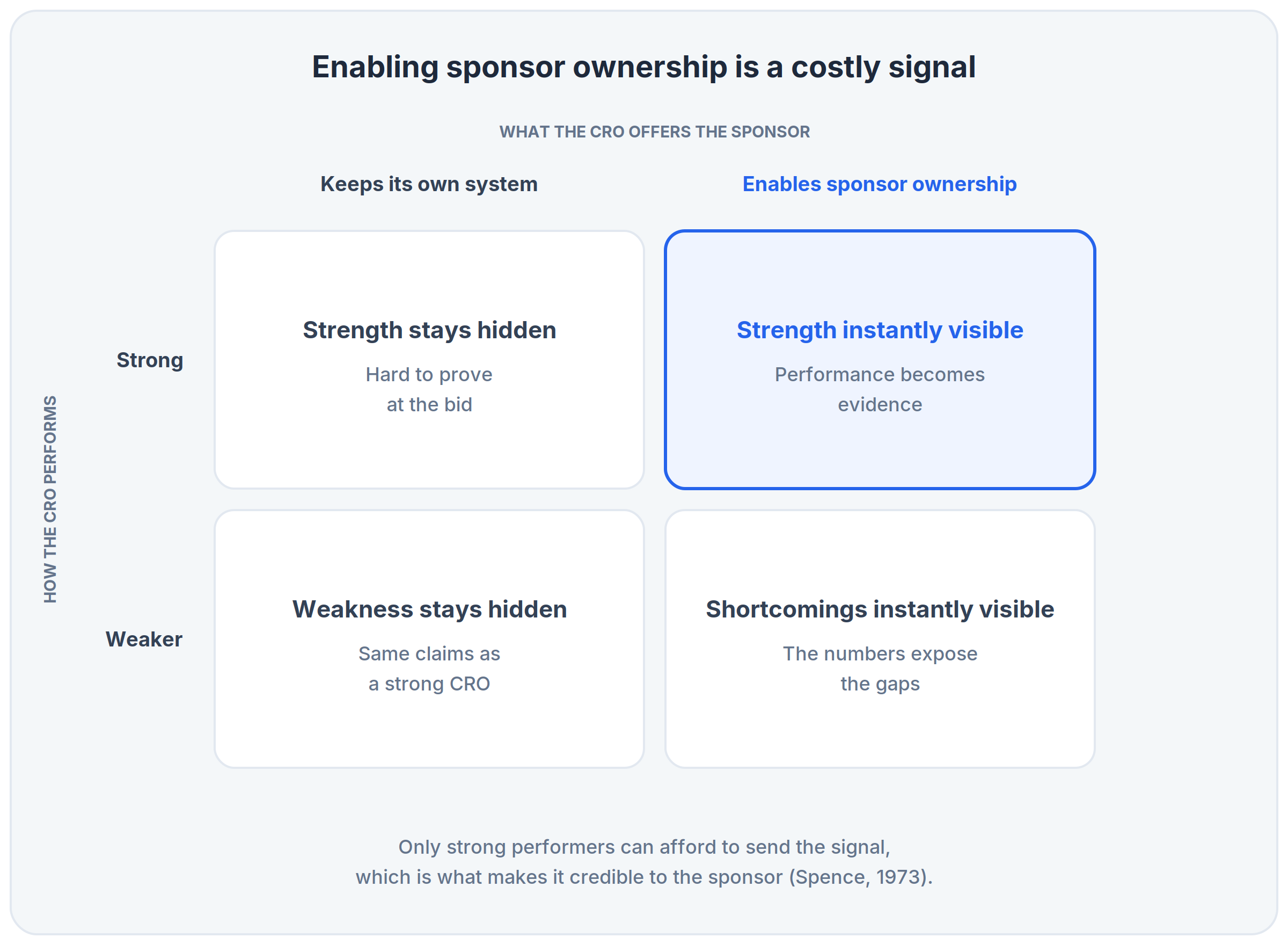
As sponsor ownership becomes the norm, a preference for the CRO's own systems will increasingly be read as information in its own right. The sponsor's question shifts from "which system will you use?" to "what does that preference tell us?" For strong CROs, this is an inexpensive way to stand out at the bid stage, precisely where quality has always been hardest to prove.
What CROs can do now
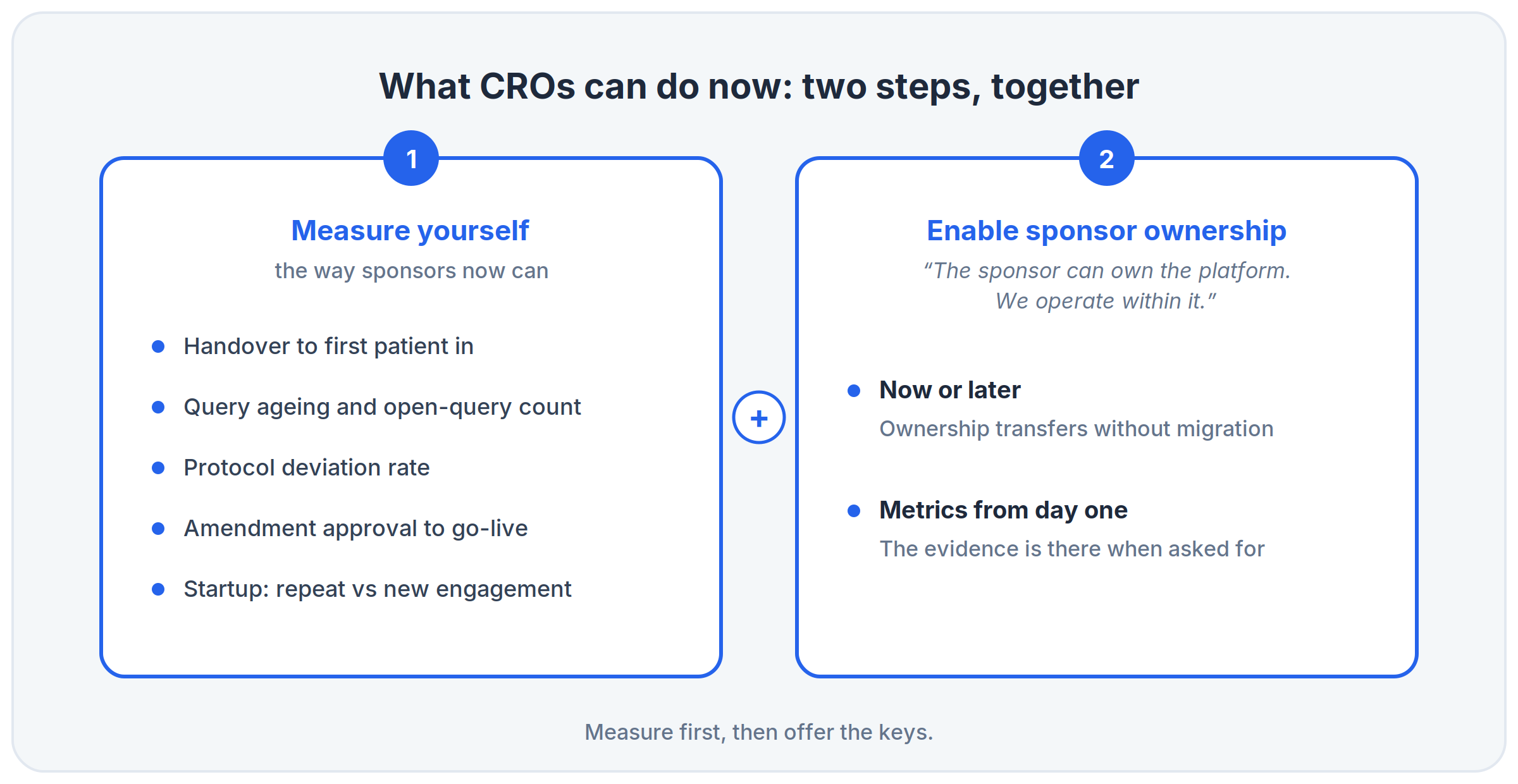
- Measure yourself the way sponsors now can. Track time from handover to first patient in, query ageing and open-query counts, protocol deviation rates, time from amendment approval to go-live, and startup time on repeat versus new engagements. More about that here.
- Enable platform ownership before it is requested. Stating in a proposal that the sponsor can own the platform, while you operate within it, turns the signal described above into a concrete commitment, before a competitor can make it. This does not have to mean handing over the platform on day one. A CRO can still run the study on a platform it licenses itself; many sponsors, especially early-stage biotechs, may prefer to wait until they are larger before taking ownership. Key is that they can do so at any point, without migration. Either way, the metrics above can be tracked from the first day of the study, so the evidence is there when the sponsor asks for it.
The second step is easier with a platform designed for sponsor ownership and CRO collaboration. At Carelane, we build exactly that platform, and we work with CROs who want to make this model part of their offer. If that's you, we'd love to talk.
The takeaway
For decades, switching costs did part of the work of keeping CRO relationships in place. As sponsors gain ownership of their platforms, that support falls away, and the relationship rests on performance alone.
That is a harder standard, but a fairer one. Quality that was invisible at the bid stage becomes measurable in every study, and a willingness to be compared, and even replaced, becomes a competitive advantage.
For the CROs that have always delivered more than the market could see, or let them charge for, this is the shift they have been waiting for.
References
- Akerlof, G. A. (1970). The market for "lemons": Quality uncertainty and the market mechanism. Quarterly Journal of Economics, 84(3), 488–500.
- Klemperer, P. (1995). Competition when consumers have switching costs. Review of Economic Studies, 62(4), 515–539.
- Spence, M. (1973). Job market signaling. Quarterly Journal of Economics, 87(3), 355–374.
