How to win the bid against a global giant
August 27, 2026
We don't sit in bid defences. We see what happens on either side of them - the numbers CROs bring to the table, and what those numbers look like six months later across 170+ investigator sites in 50+ countries.
From that vantage, something has become clear: mid-sized CROs should win more bids against global giants than they do. So why don’t they?
We believe it happens when the sponsor's team lines up the shortlist and one name has 14,000 employees, sites in 60 countries, and a logo the board already recognises. Because a key question on everyone's mind is: "Who is more likely to get this done on time?".
In a pinch, the big players can simply throw as many bodies at the problem as it takes. It's not elegant, but it works. Mid-sized CROs say they're faster and better, but so does everyone else on the list.
It’s obvious what the prudent choice is.
The asymmetry you can't argue with
The gap is real, and pretending otherwise is what loses bids.
- Scale. They can staff 40 countries without blinking and deploy as many CRAs as they want. You can't.
- Brand. Nobody at the sponsor gets fired for hiring the giant, that's a powerful incentive to overcome.
- Perceived security. Their reference list is longer than your company history. To a procurement team building a risk matrix, that's attractive.
Compete on any of the three and you've already lost.
The bid is only winnable on the one axis where their advantage inverts. Where the thing that makes them big is the thing that makes them slow.
.png)
The metric that makes the difference - speed
In The Velocity Paradox we argued that for a CRO, speed isn't a service quality - it's the margin.
The commercial version is even narrower: your edge is quantifiable agility.
Being able to prove without a doubt that you can reliably hit First Patient In 30% faster than the competition is one metric where you win bids.
Every other mid-sized CRO on that shortlist is describing itself as agile, responsive, flexible, close to its sites. The sponsor has read those words in every proposal they have ever received - including the giant's. They carry no information so the decision falls back to the size chart.
A number doesn't get ignored. It either survives the follow-up question or it doesn't.
But be precise about which speed you're selling. Sponsors don't buy velocity in the abstract. They buy the specific milestones that gate their own timeline: when the first patient is dosed, when the database locks, if they can walk into a board meeting with data.
So a claim that works has three parts. It attaches to a milestone the sponsor cares about. It carries a real measurement behind it. And it holds up when someone asks how you know.
%20(1).png)
Show proof & where it came from
Here are ideas for numbers you can put into the proposal:
1. Time to site activation - across all your studies, not your best one. How long from signing the contract to first patient in. Give the average, the fastest, the slowest, and say how many studies that covers. "Around 70 days" tells a sponsor little. "Median 71 days across our last eleven oncology studies, fastest 58, slowest 94" is more informative. Showing your slowest is what makes the rest believable.
2. Study build time. Protocol final to database go-live, in days. This is where scale works against them. The build is more manual than most sponsors assume, and a new study joins a queue behind everything already in flight. If you can do it in days rather than months, you have a strong argument.
3. How much software training a site needs before it can start. Measure it in hours of site staff time rather than using buzzwords like "intuitive". Sounds small but isn't. This is the one we see most clearly - site onboarding is measurable, and the spread between platforms is much wider than the industry talks about. A four-hour training session means finding these hours in the diary of a coordinator already running six other trials - then doing it again for every site, and again every time their staff changes. The training, annoying though it is, isn't the delay. Scheduling it is. If a new coordinator can work in your system after fifteen minutes without a scheduled session, that queue disappears.
4. Query turnaround and query aging. How many days from raised to closed, plus how many are open past 30 days right now. Open queries are what stands between last patient out and database lock, so the pile you carry mid-study comes off the end of the sponsor's timeline, not yours. Live numbers beat historical averages, and the gap between the two is usually where the problem is hiding.
5. Amendment turnaround. The time it takes from "approved" to "live in the system". Every sponsor has sat in a change-order queue for weeks, sometimes months, being billed the whole time. Name that pain, prove you're better.
6. Last patient out to database lock. The tail of the study, and the part sponsors feel hardest. After the final visit you still have queries to clear, external data to reconcile - labs, ePRO, imaging, safety - and coding to finish before anything can lock. If that reconciliation runs in batches at the end rather than continuously, all of it surfaces at once, and a study that ran on schedule loses a quarter at the finish line.
Then give them what almost nobody else can:
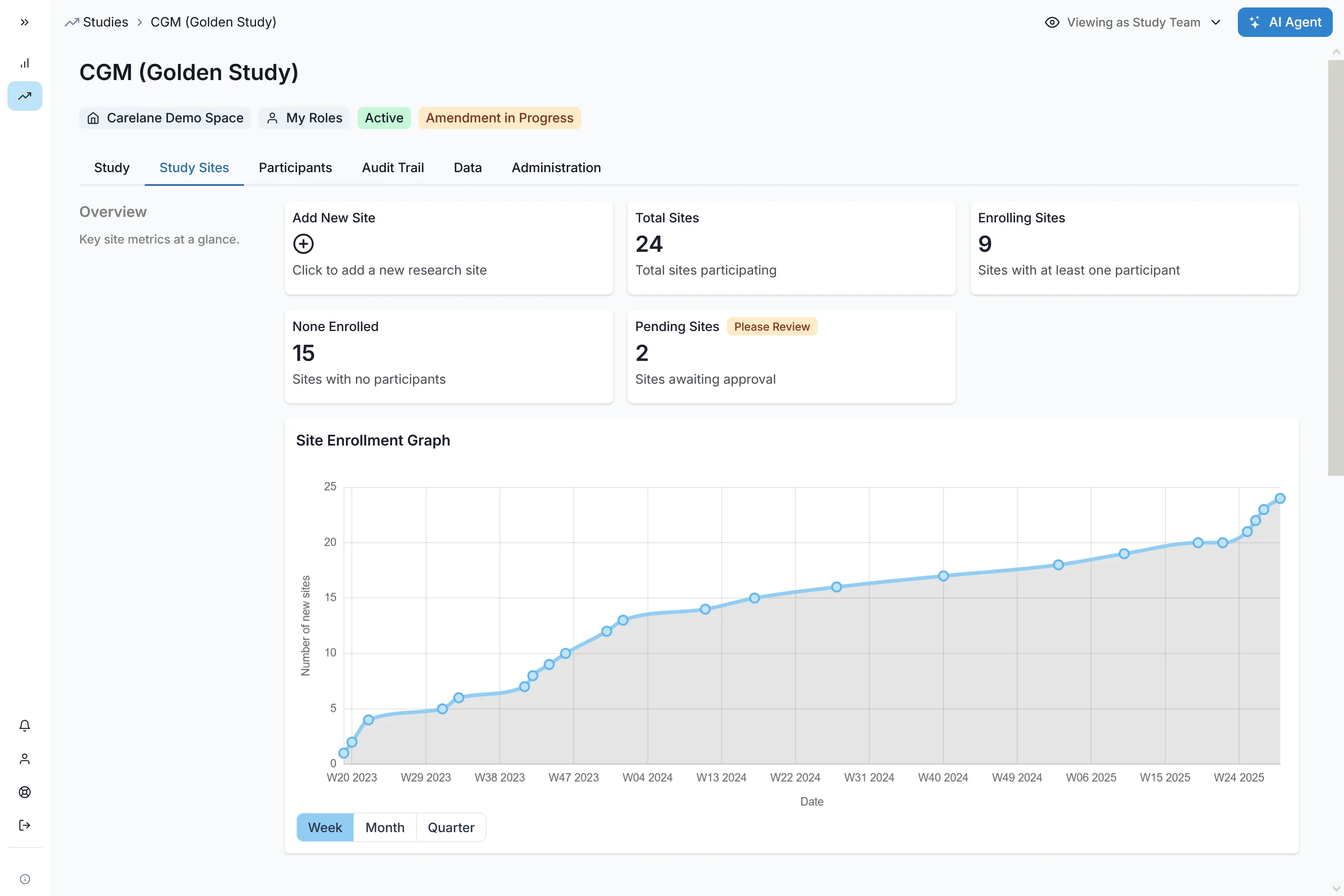
Live visibility. Give the sponsor read access to the real metrics while the study is running, not after it. The giant can't offer that - their data isn't queryable in the first place.
.png)
Be specific about what you mean, though, because "we'll be transparent" is just another empty word. Real transparency means a named set of numbers - activation status by site, open queries and their age, build and amendment turnaround - visible to the sponsor on demand, in the system, with nobody preparing anything first.
That last part is what lands. Every sponsor has read a status report and wondered what didn't make it in. Offering the raw view removes the question entirely, and it costs you nothing - provided the numbers are actually good!
Can you actually back that up?
If you can't, your bid didn't fail in the defence, it failed months earlier.
Often, the data isn't there and needs to be collected. On a fragmented tech stack, someone spends weeks pulling it out of five systems, a shared drive and the memory of a project manager. If the numbers you end up with aren’t great, this is what happens when the connective layer between systems is human. We see this constantly: EDC, CTMS, eTMF, safety, labs, each one fine on its own, none of them talking to the others. So a person exports, reconciles, re-keys, chases and confirms. Every handoff is a queue, and every queue is capped by somebody's availability.
Which is the giant's problem, reproduced at a fraction of the size and with none of the benefits. You're slow for the same structural reason they are.
A unified stack changes this at once. When activation, build, queries and monitoring run through one system with one audit trail, measurement stops being a project and becomes a byproduct. And the numbers themselves become much better, because the handoffs that held you back are gone.
.png)
.png)
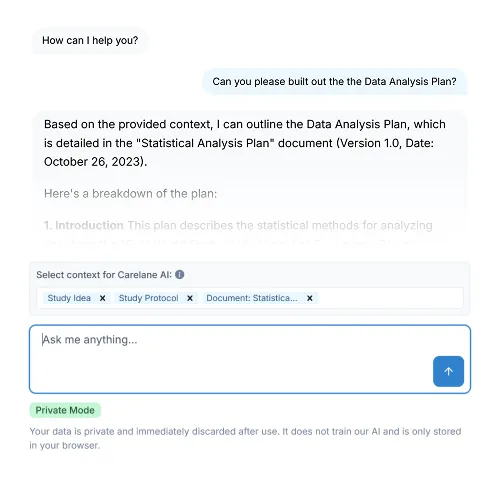
It's also the condition for everything after. AI only produces anything useful on data that's already structured, connected and traceable - bolted onto a fragmented stack it just adds another system to reconcile.
As we put it in Becoming a Tech-Enabled CRO: the stack isn't just how you run the trial. It's how you win it.
The takeaway
You don't beat the giant by being a smaller version of it. Their advantage is unlimited headcount and that nobody gets blamed for hiring them.
You beat them by outperforming them on speed, with proof to back up your claims.
The numbers win the bid but the tech stack is what produces them.
Ready to try Carelane?
From protocol to a complete study build in minutes. Experience the world's fastest infrastructure for modern clinical trials.