Becoming a Tech-Enabled CRO
June 30, 2026
The CROs that win the next decade won't be running on the stack that won them the last one.
That's an uncomfortable thing to say, because the old stack still works. It runs trials. It locks databases. It gets sponsors to their endpoints. But "still works" stopped meaning "competitive" a while ago, and the gap between the two widens every quarter.
Moving off a legacy, bolted-together infrastructure isn't a tech upgrade. It's a repositioning of the whole business. Change the infrastructure and you change what you can promise in a bid, what your margins look like, and what your people actually spend their days doing.
The stack you already have
Walk into most CROs and you'll see the same picture.
A legacy EDC at the center. Spreadsheets doing the work the EDC can't. Queries chased over email. Reconciliation done by hand. CTMS, eTMF, safety systems and lab feeds that each live in their own world and get stitched together by someone, manually, after the fact. Version control by filename: protocol_v3_FINAL_revised_USE-THIS-ONE.docx.
None of this was a mistake. Every piece was a reasonable decision when it was made. You needed an EDC, you bought one. You needed to track something it didn't handle, you built a spreadsheet. You needed to coordinate sites, you added a system. Each tool solved a real problem on its own.
.png)
The problems didn't stay on their own. They compounded. The systems don't talk to each other, so your people became the integration layer - copying data between platforms, chasing down discrepancies, hunting for the current version across five places. The stack that made sense one decision at a time now slows you down all at once. And no single piece looks like the culprit.
"It still works" is the trap
Here's what catches good operators out. The old stack isn't broken enough to force change. It limps. It produces a clean database eventually. Nothing's on fire.
That's exactly the problem.
A system that fails loudly gets fixed. A system that quietly costs you 20% of your speed and a few points of margin every study just becomes "how things are." No crisis, no trigger, no action. You tolerate the inefficiency because tolerating it feels safer than the upheaval of changing it.
This is where "safe is the new risky" stops being a slogan and turns into a line on your P&L. Holding onto the legacy stack feels cautious. You know its quirks. Your team knows the workarounds. Nothing breaks.
But while you're being cautious, a leaner competitor is bidding faster activation, proving shorter timelines, and winning the work you used to win.
.png)
The comfortable choice and the safe choice quietly became two different things. The legacy stack is the comfortable one.
What "tech-enabled" actually means
Worth being precise here, because the term gets thrown around until it means nothing.
It is not buying one more tool and bolting it onto the patchwork. Add an AI feature to a fragmented stack and all you've got is a fragmented stack with an AI feature.
Tech-enabled means unified infrastructure. Three things, concretely:
A single source of truth. Data lives in one place. The CRA, the data manager, the statistician and the sponsor are all looking at the same current state - not reconciling their own copies.
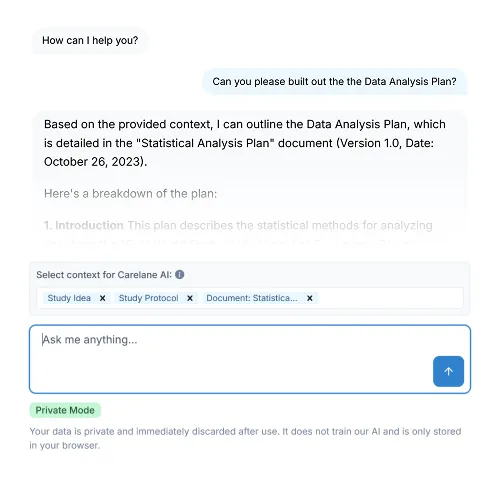
AI agents on the repetitive verification. The high-volume, low-judgment work — query identification, consistency checks, routine source verification - runs without a person doing it by hand. Every action logged. Every action reviewable.
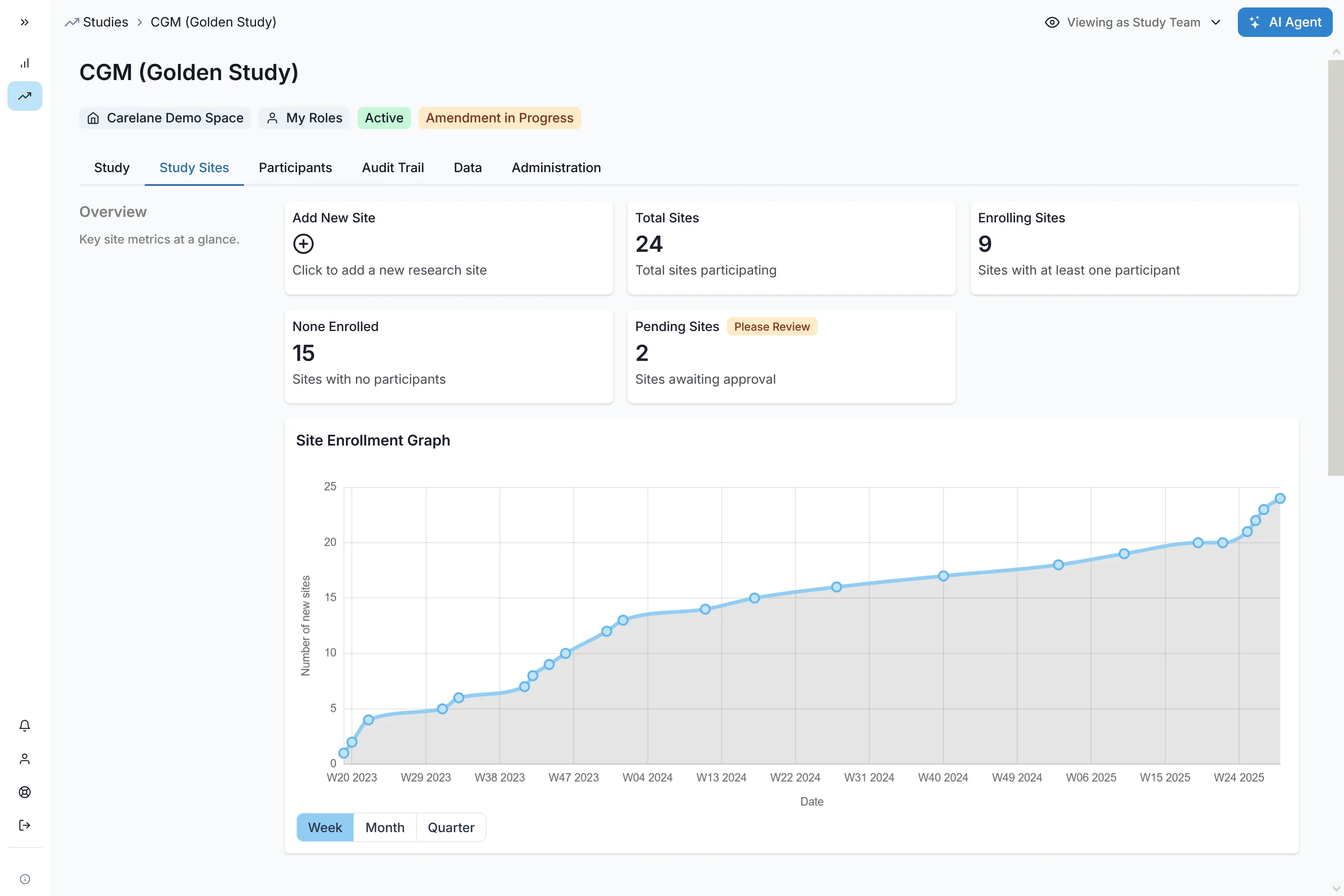
Real-time visibility across studies. You see the actual state of your portfolio now, not in next week's status report. You manage by what's happening, not by what got reported.
%20(1).png)
The thread running through all: your people stop being the integration layer. The infrastructure does the connecting and the repetitive checking. Your experts go back to being experts.
Getting there without the rip-and-replace nightmare
The objection writes itself. We run live trials. We can't tear out our infrastructure mid-study.
Correct. And also the old objection. The fear of a big-bang migration - everything down, everyone retrained, ongoing trials at risk - is why a lot of CROs never start.
But that fear describes a way of migrating that doesn't have to be the way anymore.
A modern transition is phased. You start with a contained, lower-risk surface: one workflow, a new study, a single repetitive process that's clearly bleeding cost. You prove it works. You build the audit trail. You expand from there. Trials already running stay where they are until it makes sense to move them.
.png)
Low-friction onboarding is what makes that possible - one login instead of five, minimal retraining, infrastructure built to absorb your process rather than force a rebuild of it. The transition protects the trials in flight precisely because it doesn't demand you move them all at once.
The rip-and-replace nightmare describes legacy migration. It doesn't describe what this has to be.
What it buys you in the bid
This is where the infrastructure stops being an internal efficiency story and becomes a commercial one.
On a legacy stack, your competitive claims are adjectives. "Better communication." "Strong project management." "A collaborative approach." Every CRO promises these. They're unprovable, so sponsors discount all of them equally.
A modern stack lets you trade adjectives for evidence.
Claim faster first-patient-in - and point to the activation data. Claim cleaner data - and show the reconciliation running continuously instead of in batches. Claim real-time oversight - and demonstrate it in the room.
The infrastructure is what makes the claim defensible. And a defensible speed claim beats a vague promise every time - especially when the sponsor is already reading scale as slowness, looking for a reason to believe you're the faster, lower-risk choice.
.png)
You can't make those claims on infrastructure that can't back them up. The stack isn't just how you run the trial. It's how you win it.
The takeaway
Becoming tech-enabled isn't about chasing the newest tools. Tools come and go. A CRO that reorganises around whatever's shiny this year is just building a new patchwork.
It's about building the infrastructure that makes every other claim provable.
Speed. Margin. Retention. None of these are won by saying them. They're won by having the thing underneath that turns them from promises into facts you can demonstrate.
That's the repositioning. The technology is how you get there - but what you're building is a business whose advantages are visible and whose claims are true.
In a market learning to re-price exactly those things, that isn't an upgrade.
It's the difference between competing and being competed against.
Ready to try Carelane?
From protocol to a complete study build in minutes. Experience the world's fastest infrastructure for modern clinical trials.